

Electrification still matters
From one Earthling to another, amidst NY's clean energy hand-wringing


This morning, Governor Hochul officially proposed changes to New York’s Climate Leadership and Community Protection Act.1 While the proposal keeps our decarbonization targets in place, it guts any chance of us achieving them!
Her proposal delays implementing new regulations until 2030 — making our 2030 targets (reducing emissions by 40%) themselves pretty meaningless and wasting valuable time that could be spent making progress toward our 2050 goals (reducing emissions by 85%).2
Dear friend, allow me to suggest that now is the time for more electrification, not less. And with the right policies, we can make the clean energy transition fairer, faster, and more affordable for all of us.
I’ve dug into the facts and the myths and the fear-mongering to try to make sense of it for us. I’m biased, yes, but only because I’m an Earthling who loves her home planet. Join me, your favorite Electric Coach, on a “What’s Going On With New York’s Clean Energy Law” tour, complete with footnotes:

The real driver of high utility costs? Fossil fuels
A leaked NYSERDA memo has been widely cited as evidence that climate mandates will dramatically increase household costs. But the picture is more nuanced and decidedly more geeky, because we have to talk about accounting rules. If you know me, you know that I don’t like to talk about accounting rules! Alas, we must.
Yes, the memo warns that meeting 2030 targets under the current accounting rules could lead to high costs for households and businesses. But experts on the state’s Climate Action Council immediately pointed out something important: the memo doesn’t include analysis of any rebates or affordability programs.3 We need a true cost benefit analysis, and right now they’ve only got the costs included. That’s not a complete or accurate picture.
Speaking of accounting rules, the Governor’s proposal includes new rules for measuring emissions. They would weaken emissions reporting, but they’re also in line with global norms so I’m inclined to let this part slide.
An expert from the Climate Action Council also notes that U.S. gas exports—not New York’s clean‑energy transition—are currently a major driver of high utility costs. In other words, global fossil fuel markets are pushing bills up far more than the state’s climate laws. And it’ll only get worse as this immoral war with Iran continues.4
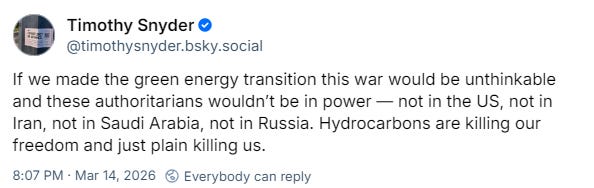
Here’s a good analysis from Bill McKibben on Iran, Venezuela, Cuba, Ukraine and China:
“And it’s about survival, as the rest of us imagine rebuilding a world that might actually work for its inhabitants. We have a few humble but powerful tools—the solar panel, the windmill, the battery—that make it easier to imagine something other than our current nightmare.”
If we want protection from unpredictable global fuel spikes (cough, Strait of Hormuz) then electrification, powered by renewables, is the long‑term solution.

Our current system is already unaffordable
This part is crucial: New Yorkers are struggling not because of electrification, but because the fossil fuel‑heavy system we have is delivering some of the highest electricity prices in the nation.
New York’s average residential electricity price per kWh is 59% higher than the U.S. average, which marks the highest gap since 2001. What’s more, prices rose 12% over the past year which far outpaces inflation.5 Since 2018, prices here have risen more than 50%.
This is the system critics want us to keep relying on?! This is the one they think will lead us into the future? This is what they want to lock us into? My goodness. I’ve often marveled at how quick we are to adjust our thinking to new tech, except if it’s related to clean energy. We just can’t imagine that heat pumps work in cold weather, that solar is now the cheapest way to make energy and that electric cars are reliable. But guess what? It’s all true.

And despite the political noise, it’s clear that fossil fuel markets are not delivering affordability. As Empire Center analysts put it, if “most of the country enjoys cheaper electricity,” something in New York’s reliance on legacy energy systems “is not working.”6

Demand for electricity is rising
Nationally, grid planners are warning that AI data centers and emerging technologies are pushing electricity demand sharply upward. We should be pushing back against these data centers wherever they’re planned, but assuming we don’t win all of those fights, we’ll still need more electricity to power the AI overlords.
The question isn’t whether New York’s grid will need to expand, it’s how we power that growth. We could try to meet that demand with fossil fuels, exposing families to volatile fuel prices and continued pollution and ecological devastation… or we can build it on clean, stable, renewable energy. The choice is ours.


Clean energy lowers costs when paired with the right policies
That same leaked memo from NYSERDA actually predicts savings for “high efficient electrification” households that have converted to nearly all-electric power. City and State says, “Accounting for affordability benefits, ‘high efficient electrification’ households upstate could save about $1,500, while those in New York City could save $800.” More proof that the current energy system isn’t working for New Yorkers, and that we need to prioritize efficiency and electrification. But we need to make sure our policies align with that goal.
Instead of abandoning our climate goals, let’s modernize them
Governor Hochul has pointed out that parts of the 2019 climate law need updating due to inflation, legal challenges, and the need for more flexible pacing. I am sure this is true! Everything is different now than it was in 2019. On the local level, we just went through a similar update of a similarly controversial law — Albany’s inclusionary zoning — largely because the building and financing environment had changed so much that policy tweaks were needed.7 This is good, actually! Policy should be responsive to real conditions on the ground.
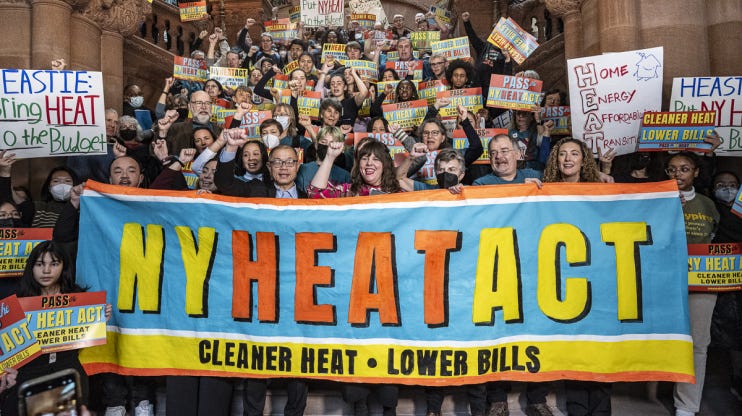
I’m out of my depth when it comes to knowing how the state will address this. Here’s what I’ve gathered, but help me out with what I’ve missed.
➡ The Assembly has proposed a budget that sends direct utility relief checks to New Yorkers and calls for a two-year freeze on utility rates. I mean, I don’t really know how helpful those checks would be but a utility rate freeze is good.
➡ The Senate’s budget proposal includes funding for a Sustainable Future Program, Thermal Energy Networks, weatherization and electrification and heat pump rebates.8 That sounds good!
➡ The Governor has a proposal to require AI companies to pay their fair share of costs to upgrade the grid (sounds great) and something about tying executive pay to energy affordability (love it).9 This morning’s proposal, however, abandons our 2030 emissions reductions goal and will set us back on our 2050 target too.
There is both a climate crisis and affordability crisis today, and we have to solve for both. We can do that by demanding polluters pay through Cap-and-Trade, updating our tax codes to make the ultra-wealthy pay their fair share and then using that revenue to provide relief to regular people while ensuring they benefit from a clean energy transition that is stable, affordable and healthy for people and the planet.
This isn’t the moment to pull back. It’s the moment to double down on our clean energy future and do it right.

https://empirereportnewyork.com/climate-action-and-affordability-can-and-must-go-hand-in-hand/
https://www.politico.com/news/2026/03/20/hochul-new-york-climate-law-proposal-00837394
https://spectrumlocalnews.com/nys/buffalo/politics/2026/02/27/n-y--climate-action-councilmember-on-high-utility-costs
Ibid. Is that the thing to say when you are quoting the same source as the footnote before?
https://www.empirecenter.org/publications/new-yorks-residents-hit-with-record-electricity-prices/
https://www.empirecenter.org/publications/empire-center-warns-of-sharp-increase-in-new-york-electricity-prices/
Ok fine, I’ll write about inclusionary zoning too.
https://buildingdecarb.org/new-york-policy-updates
https://www.governor.ny.gov/news/governor-hochul-announces-psc-proceeding-her-plan-ensure-data-centers-pay-their-fair-share
We keep repeating our poor choices.
As always well researched and written👍